 Episode 3
· 27:38
What do the people behind the shelter's
front desk wish you knew before you fell
in love with a pair of big brown eyes?
Today, I'm sitting down with someone
who spent 13 years giving homeless
pets a second chance, and she's
telling us what really happens
between the kennel and your couch.
Stick around
Hello and welcome.
I'm so glad you're here.
I'm Dr.
Jennie Marvellee, and this is
Whisker Wise Organized Pet Care, the
show where love meets preparation.
We're here for pet parents who love their
animals fiercely and want to do right by
them, from the very first day they come
home to every stage of life that follows.
Whether you've just adopted your first
puppy, brought home a senior cat who
needed a second chance, you're still at
the should I even get a pet stage, or
you have a pet and you wanna brush up and
organize your pet care, you belong here.
Before we go any further,
please know I'm Dr.
Jennie Marvelle, a licensed veterinarian,
but I'm not your veterinarian.
Nothing in this podcast constitutes
veterinary advice for your individual pet.
This is general education for pet parents.
For medical concerns about your specific
animal, I encourage you to reach out
to your own amazing local veterinarian.
Okay, now that that's out of the
way, let's talk about pet adoption
Jennie Marvelle: Last
Stevanie Scott: episode, we
talked about choosing the
right pet for your actual life.
Adopt versus shop, dogs versus cats,
Jennie Marvelle: and the
Stevanie Scott: the questions
to ask before you commit.
Today, we're walking
through the shelter doors.
The amazing people who work in
shelters see the whole story.
Jennie Marvelle: They
Stevanie Scott: see the hopeful first
meeting, the nervous first week, and
sometimes they see the return, not
because anyone stopped caring, but because
nobody told the adopter what to expect.
Jennie Marvelle: So
Stevanie Scott: So today, we're
going straight to the source.
My guest and I are going
to explore three things.
Jennie Marvelle: First,
Stevanie Scott: what shelter staff are
hoping you already know when you walk
Jennie Marvelle: adopt.
Second, how
Stevanie Scott: how to set
up a new pet for success
Jennie Marvelle: in
Stevanie Scott: in those
critical first days and weeks,
Jennie Marvelle: including
Stevanie Scott: when to worry and-
Jennie Marvelle: to just give it time.
And
Stevanie Scott: Third, the pets
who get overlooked and all the ways
you can support your local shelter
even if you're not ready to adopt.
Jennie Marvelle: So I
Stevanie Scott: I could not have picked
a better person for this conversation.
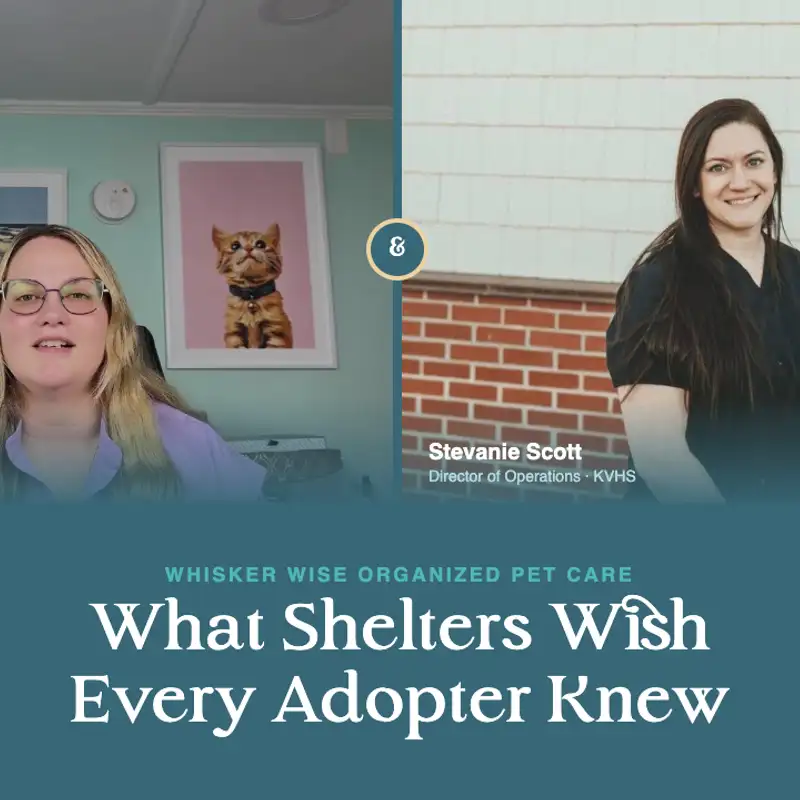
Stevanie
Scott is the director of operations
at the Kennebec Valley Humane
Society right here in Augusta, Maine.
Jennie Marvelle: She
Stevanie Scott: earned her degree
in biology before discovering her
passion for animal welfare in 2013.
Jennie Marvelle: Throughout
Stevanie Scott: her career, she's
helped thousands of animals and
played a key role in the $8.3
million capital campaign that led to the
creation of the new Kennebec Valley Humane
Society facility, the Nancy Schumann
Jennie Marvelle: Animal Shelter.
Stevanie Scott: One of her primary goals
now is to continue growing through the
KVHS community clinic to better support
the needs of the community served.
She's been at KVHS for nine years.
She leads a team of about 20 technicians
who provide direct daily care to
all the animals at the shelter.
And
Jennie Marvelle: And
full disclosure, she's also
someone I've known and worked
with
Stevanie Scott: in this community, so I'm
super excited to have her here with me.
It's a real treat.
Um, so hi, Stephanie.
Thanks for being here.
Yes, thank you for having me on.
Thank you, Jennie, for that introduction.
I'm super honored to be here, and it's
exciting for you to create a podcast that
bridges the gap between when a human gets
their first pet or they're, you know,
experienced pet owners, and it leads you
into eventually their end of life care.
So this is a great podcast to get everyone
on board, to give them a resource and
being able to help them through those
first to end stages of pet ownership.
A little bit about myself.
My name is Stevanie Scott, as Jennie
said, and I'm the Director of Operations
at the Kennebec Valley Humane Society.
I oversee a lot of portions of the
shelter, ranging between medical care
or surgery to daily kennel operations.
So my job is to provide support to our
staff and our animals to make sure they
have everything they need to be successful
Jennie Marvelle: So what does an
average workday look like for you?
Walk us through that
Stevanie Scott: There's
no day that's typical.
Uh, every day has its own challenges.
Um, but for the most part, it starts
off with just daily kennel operations,
making sure animals are provided with
their needs and our staff is provided with
anything they need to help those animals.
From there, it's dealing with the
public, making sure our community
members have what they need, if they
need advice, if they need numbers to
veterinarians that are accepting patients,
if they need numbers to trainers.
We're here simply to support them,
and that's also a big part of my job.
We are also hoping to get into a
community clinic where we can physically
help our community by reducing the
number of animals that are being born.
We want to offer discounted
spay/neuter, vaccine clinics.
We just have to get there.
So we're very excited for our future.
Jennie Marvelle: It's definitely
needed in this area and probably
in most areas of the US right now.
So that's great.
I'm excited to see that happening.
Um, what's a part of your job that most
people don't expect when you describe it?
Something that's a little
bit out of the ordinary
Stevanie Scott: I don't think people
expect a shelter to focus on retention
and trying to keep pets in their home.
We not only adopt out animals and
take animals that don't have homes
or are stray, we also want to keep
them where they're comfortable.
So if you're having trouble with
any medical or behavior needs,
we're here to support you.
We wanna be able to offer the
resources needed to keep that pet happy
Jennie Marvelle: Um, thank you for
being there and for doing that because
I think it's a huge service to this
community, and it's not an easy task.
You're up against some, some really
hard problems sometimes, and trying
to find people resources and ways
to help is, is really hard to do.
So thank you for all that you do.
Stevanie Scott: We understand that
vet care is sometimes hard to come
by, and, you know, financial burdens
are a thing, and being able to provide
discounted services is a goal of ours
Jennie Marvelle: When someone walks
in to adopt a pet, what is something
that you wish that they knew?
Stevanie Scott: Things we wish people knew
walking through our doors is that adopting
an animal is a lifelong commitment.
There are gonna be struggles, there's
gonna be challenges, and working through
those are a part of pet ownership.
You're gonna wanna research the breed.
If you're coming in looking at
a specific breed, research it.
Make sure it's something that's
gonna fit in your family.
Um, if it's too active, if it's,
uh, meant to be a guard dog, just
realize what you're getting into
and really do your research on that.
Um, and also, no animal is perfect.
Um, you're gonna get a variety of
personalities, a variety of quirks,
and just, you know, being able to-
Really understand your animal,
really get to know him, form a
relationship, and just know that it
is a lifelong commitment to adopt
Jennie Marvelle: And I think, , you
bring up some good points.
Um, we talked about in the last
episode, you know, finding a pet
that's for your actual lifestyle,
not like the lifestyle you want.
A lot of people will be like, "Oh, I love
the looks of a Doberman," or, "Cattle dogs
Dogs are wonderful and, and I
had a cattle dog for 16 years.
She was absolutely the best dog ever,
but
she's not for everybody.
And,
I'm at
at a stage in my life now that I'm
not sure I could handle a cattle dog.
so
it's important to kinda like know
what you want, but also know your
limitations and find something-
something that really matches
for, for a long-term commitment.
Stevanie Scott: Yeah, definitely
take your time, have patience.
Uh, let the animal pick
you is what I often say.
Uh, you're not gonna come into
a shelter, find an animal that
directly is what you need.
Um, you're gonna have to, to find a few.
You might go through, you know,
several dogs before you find one
that matches with your family.
Um, just be patient and don't rush through
Jennie Marvelle: I think that kind of
gets us to like, I feel like when I'm
looking for an animal, I always feel bad,
like, going in with an animal and then,
like, deciding that one's not for me.
Like I'm leaving it to
someone else kind of thing.
Um, what do you think is the most
common thing new do- adopters
underestimate about bringing a pet home?
Stevanie Scott: What is the most
common thing new do- adopters
underestimate about bringing a pet home?
Um, I think they mostly underestimate
the amount of change in their lifestyle
that this pet is going to bring.
Not only is it a change for the pet,
but it's also a change for the owner.
You now have to get up, you know, you
have to let the dog out, you have to
feed the dog, or vice versa with a cat.
You're gonna wanna give yourself
and your pet time to settle in,
time to understand what your
routine is, and also make it theirs
Jennie Marvelle: Right.
Speaking about, like, what the
animal's going through, um, there's
a lot of change that happens.
There's change at the shelter, there's
change when they get home, there's getting
used to new things and being under stress.
What does
What does the shelter experience
actually look like for an animal?
What are they going through emotionally
there?
Stevanie Scott: there?
It is a variety of emotions
depending on the animal.
Uh, some animals go from
laying on a couch to being in a
kennel where they're confused.
They don't understand why.
Uh, I always say I wish animals could talk
or if they could understand us, um, where
we could better explain the situation.
Other animals come in and
they're like, "This is awesome.
Uh, you know, there are so
many friends to play with.
Like, it's exciting.
I'm always with a different person
walking, you know, doing adventures."
Um, those are a little bit easier
to settle into the shelter.
Um, and we always have our, our
animals that come in very shut down.
But also watching that experience
from when they come in shut down
to them being happy, adoptable
pets is extremely rewarding
Jennie Marvelle: How does the transition
from shelter to home typically go?
Like, what should adopters
expect in those first few days?
Are they gonna, you know,
have the dog come right to
Stevanie Scott: to them all the
time, or is there like a period where
Jennie Marvelle: those animals
have to adjust a little bit?
Stevanie Scott: It can take days, weeks,
months, all depending on the animal.
I've heard a variety of stories.
If it's, you know, I adopted a
semi-social cat, and it took three
months before I was able to pet him.
Um, that cat just needed that extra time
to trust and to feel at home and safe.
Uh, other animals, you know,
within the first few days they're
showing their true personalities.
They're getting used to the routine.
Again, they're thinking this is awesome.
So it totally depends on the
pet and their personality.
So the shelter's doing
everything they can-
Jennie Marvelle: that animal up to
succeed, and then it's our turn.
let's talk a little bit about,
like, what makes the difference
in those first few weeks.
If you could send an
Stevanie Scott: adopter out there
Jennie Marvelle: door with, like,
a three-item checklist, what would
Stevanie Scott: would be on it?
Hard to do three items.
But I would say patience, um, we
talked about that a little bit
with finding the correct match.
So come in being patient.
Set realistic expectations.
Um, it's going to take some time
for your dog to learn your routine.
If they have an accident in the house, um,
if miss a meal, that's completely normal.
They just have to get used to
their new home, their new family
Jennie Marvelle: What are some signs
that a pet is adjusting well versus
signs that, like, a new owner should
be concerned about the adjustment?
Stevanie Scott: So I would say all
animals adjust at different times.
Again, um, you're gonna see
progress instead of perfection.
As your animal slowly gets used
to you, you're gonna see true
personalities, you're gonna
see definitely more affection.
Um, and eventually after some
time, they'll also feel safe.
Um, I think that's the biggest thing
is a lot of pet owners, new pet owners
expect their animal to adjust super
quickly, and it's not always that case.
So just, you know, continue the
patience, continue being kind to not
only your animal, but also yourself.
You know, you're not alone if
you're feeling overwhelmed.
Um, it's actually very common.
You just have to take it day by day.
Jennie Marvelle: I know
I recently adopted
you a new kitten.
Um, thank you for that.
He's adorable.
Um,
and when we came into the shelter,
like he jumped right into my arms.
He was super affectionate,
and he was like that for
a
a few weeks when we came home.
And
And now he's starting to
kind
feel himself a little bit more.
He's like stealing things off the
counter and knocking over plants,
and I have to remind myself that
this is an adjustment for both of us.
It's been a long time
since I had a tiny kitten.
kitten.
Um,
so I think it's true of everybody,
and it's not, um, it's not any
judgment on, oh, I'm a bad pet parent
or like this is a horrible cat.
He's,
He's, a
a kitten that's showing
me what his personality's
gonna
gonna be like and that I'm gonna have to
maybe
not have so many houseplants.
so I
I think that those are
all really important-
things that you talked about.
Um, and I
And I know,
everybody's on
on their own timeline.
There's not,
a
a set in stone, okay,
this is when I worry.
But is there,
a
rule of thumb for when to be concerned
if you have a
if you have a cat that's,
a
hiding or a dog that's
not approaching you well?
is
is there a time period that you would want
to reach out if that's not happening?
Stevanie Scott: somebody to reach
out if that's not happening?
Yeah.
So for us, our rule of
thumb is called 3-3-3.
A dog will take three days to decompress
from the shelter, uh, three weeks
to learn your routine and match it
with his, his or her, her routine,
and three months before, you know,
their true personality's coming out.
They're…
As you know with your kitty,
it, it takes some time.
Um, but you're gonna see
them show more affection.
They're going to, uh, again, feel very
safe and feel comfortable identifying
their new friends, um, you know, being
more comfortable outside of the home
and just in general with their people.
They're happier
Jennie Marvelle: Do you think the
three, three, three works just
as well for cats as for dogs?
Stevanie Scott: I think cats
are always, uh, their own breed.
Um, for the most part, I do believe three,
three, three is a good general rule.
Uh, depending on the cat's personality,
depending on if it was found as a
stray that never had a home, or, you
know, they have lived the best life
and had some unfortunate events happen
where they're now finding a new home,
they all take a little bit different,
timeframes before they adjust.
Jennie Marvelle: rules
quite as much as the dogs do
Stevanie Scott: Still like
rules quite as much as dogs do.
Yes.
Cats definitely don't.
Um, and cats definitely show their
emotions differently than dogs.
Um, you know, it might not be working.
You might wanna ask for help, you
know, if your animal is not eating
or drinking for long periods of
time, or vomiting or having diarrhea.
Major signs of stress, you know,
you should probably contact somebody
that can give you advice, whether
it be your veterinarian, your local
shelter, a trainer, you know, any type
of situation that works for you, so.
I would say-
Jennie Marvelle: if you have a really
chonky cat, we want them eating
within 24 hours, so maybe be more
on, on the ball with, with calling
somebody if that's not happening.
But for most pets that are young
and healthy, like one to two days of
days of not eating okay
More than that, definitely call your vet.
Make sure that they have water
in wherever they're hiding,
um, and food access available.
But yeah, th- those are all great.
And you know, worst case scenario,
call your local veterinarian or
call the shelter where you adopted
and say, "Hey, is this okay or
Stevanie Scott: worst case scenario,
call your local veterinarian or
call the shelter where you adopted
and say, "Hey, is this okay, or
should I need to do something?"
And a lot of shelters do offer
literature for people to read, whether
it be, you know, if they're not using
the litter box, if they're not eating
appropriately the first few days.
Um, and we recommend
reading through those.
Sometimes, you know, moving a
litter box or changing the type of
litter, changing the type of food
really alters what they're doing.
So, you know, sit down, read
the literature we're offering
you, and always ask for help.
Don't be afraid to ask for help.
Everyone's going through the same kind of
situation when they're adopting a new pet
Jennie Marvelle: What do you think
is the most common reason you have
people calling you in a panic saying
like, "This isn't what I expected"?
Stevanie Scott: I think the most common
questions we get post-adoption is
we're not developing a relationship
quickly, and relationships do take time.
Um, you're not gonna
form a bond overnight.
It does, you know, take a little time.
And just because you're having trouble
does not mean that you picked the
wrong pet or you did the wrong thing.
It just takes a little bit more time,
and there's never a time where you f-
should feel ashamed if you do have to give
your animal up because it's not working.
We recommend giving it time,
but there's also a point where
you may be at a dead end.
It may really not fit in your family.
And just
Don't be embarrassed.
Um, a lot of people have to go through
that, and we're just here to support.
I
a new pet into a
think Patrick's weighing in.
Um, if you are bringing
a new pet into a situ-
Jennie Marvelle: with other pets, um,
Making sure that their introduction is
very,
slow,
um,
and that you read through the
literature on how to introduce
pets to each other is important.
I know he was a little rocky at the
It was a little rocky at the
start with the new kitten.
Um, he loves other cats, and we got this
for him and, and at first he was very
the idea, but now they're great together.
Um, but for
anti the idea- … but now
they're great together.
Um, but for sure you wanna read through…
The shelters are wonderful these
about giving out literature, um, and
kind of walking you through processes.
So if you have things that when you're
adopting you're wondering about, like
how do I introduce them to my dog, what
does that look like, just make sure
that you ask them for some guidance
and some information and they'll
about giving out literature,
for
you through processes.
So if you have things that when you're
adopting you're wondering about, like,
and I
"How do I introduce them to my dog?
What does that look like?"
Just make sure that you ask them for
some guidance and some information,
and they'll get it for you.
Um- Absolutely.
And I think that reassurance that
you just gave us all is everything,
normal
for a pet is
a
a much wider lane than what
new pet parents think.
Um, so
most
I wanna
new pet parents think.
Um, so now I wanna talk a little
bit about some harder things
about the
the pets who
wait the the
longest at the shelter.
Um, let's
let's talk about who gets overlooked.
Which
Stevanie Scott: animals do you think those
are, and who's the hardest to adopt out?
So a lot of our animals that get
overlooked are, are animals with medical
cases, if they're on special food, um,
if they're on certain prescriptions.
Then we have a lot of bonded pairs.
So sometimes we have bonded
cats, rabbits, dogs, a variety.
Um, and taking two home instead of
one puts a little bit more pressure
financially on people, so they tend to
last a little longer in the shelter.
The third animal would be our seniors.
Um, while we do have good luck with senior
cats, um, our senior dogs tend to take
a little bit longer to find their home.
, But I like to mention that animals
that have medical histories,
it doesn't define that pet.
Um, most of the time their medical
is now controlled and you're
just simply keeping that going.
Having a good relationship with your
veterinarian is always positive, but we're
sending you home with something that's
already controlled and we just want senior
pets to have that same opportunity to be
a couch potato, a snuggle bug, to have
that companionship before end of life care
Jennie Marvelle: and I think, you
know, the next time I am in the market
for a new pet, I'm definitely going
the senior route because I, I just
recently went from losing some very
senior pets and getting new babies and
oh man, is the new baby stage harder.
Like a lot of people maybe shy away
from the older pets because of the
pain of loss, um, and not wanting
to have to go through that soon.
Um, but the truth is that, you know,
nothing is guaranteed to us, right?
And it could happen to anybody at any
time, and the amount of love that you get
from those pets that are just snuggling
through their last few years, um, the pain
of loss is the price of admission to a
life with them, and it's totally worth it.
It, it's a high price sometimes.
It is a lot of pain, but it is 100%
worth it.
so
so thank you
for
shining a light on the seniors.
I think that's wonderful.
Are there some animals
in the shelter right
that
now that you'd like
listeners to know about?
Maybe people that are local to Maine that
there's
ones that have been there
for a long time, or,
Anybody come to mind that you
wanna give a shout-out to?
Stevanie Scott: So I'm gonna try
to champion a few of our dogs.
I won't name them, um, but they're
mostly our mid-adult, you know,
teenage dogs that have a lot of energy.
Um, when people come to look at
them to do a showing, their energy
almost deters them from adoption.
But a lot of times they're just pent up.
They wanna get their energy out.
They wanna chase a ball.
They wanna play tug of war.
And for some, that energy is
almost too much during the showing.
Um, so I wanna reach out to our active
fans, you know, the active families
that go for walks every day, that go
for runs, that are hikers or any type
of exercise that a dog would also love.
Like, come meet them.
They're just willing to learn.
They're ready for new commands.
They're ready to please their
humans, and I wish people saw them
for what they could be instead
of what they are at the shelter.
Jennie Marvelle: It's really hard when
you have that, like, one snippet of
time and it's a snippet where they're,
like, they've been in a cage for
hours and hours, and they're young
and energetic and they just need to
get that energy out before they can
really, you know, lay down and chill.
I know with my own dogs, I am not
gonna have a pleasant day off unless
I exercise them for a few hours
at the beginning of it, and then
Yeah
have a great time relaxing.
Um, but there's no way to get there
without doing that exercise bit first.
Right
a lot of sense.
What is, like, the most heartwarming
adoption that you've been a part of?
Are there any, like, things
Things that stick out to
you that were like, "Oh
I've ever done"?
Stevanie Scott: There are a few.
Um, my favorites are always
adopting to elderly and veterans.
Um, a lot of times animals help them in a
variety of ways, whether they have PTSD,
if they just lost their spouse, you have
that companionship, and to me, there's
no better companionship than a pet.
Um, but one of my favorite stories
of adoption was a bonded pair
of dogs named Jack and Diane.
They were found in a
cemetery tied together.
Um, didn't like any other dogs but
each other, and once separated, it
was very clear that they were bonded.
Um, we had them for close to a year, and
we performed a, a dog wedding for them.
We tried to reach audiences
outside of our community because
they were, you know, older.
They were in their, you
know, 10 to 12 years old.
Had arthritis, the basics of old dog.
Um, and when we finally found
that adopter, it was incredible.
We were blasted on The Dodo, you know.
Ellen had mentioned us for,
you know, the dog wedding, and
it still took about a year.
Um, but we finally had an older
gentleman that had lost his favorite
dog, and he had room for the two.
And even though he lived pretty far
away, we were able to meet him halfway
and make that kind of transition for
Jack and Diane into their forever home
Jennie Marvelle: That's awesome.
Thank you for sticking out with them.
That must have been so hard to wait,
like, a year knowing how great they
are and that nobody's seeing it yet.
Um, so I'm so glad that you guys did that.
What do you want everybody listening today
to walk away from this episode knowing?
Stevanie Scott: Shelters
aren't just here for adoption.
We're here to answer questions,
provide advice, provide resources.
We're not only looking for adopters, but
also if, you know, you can volunteer,
if you can foster, if you can donate,
or even share our posts on Facebook.
It is helping a wide variety of
animals find homes, and it reaches
audiences that we may not always reach.
Um, so if you're looking to, you know,
help us out, you can always share our
website, you can share our Facebook page.
We're very active on Facebook.
Um, just to reach more viewers and
hopefully, , get more adopters, donors,
volunteers, all of the above to help
us, uh, continue shelter operations.
Jennie Marvelle: So much.
And I will definitely share, the links to
Instagram and Facebook and your website
in the show notes today, um, in case
anybody wants to follow along and, and
share the things that you're sharing.
Um, is there anything I didn't ask that
you were hoping to talk about today?
Stevanie Scott: Along with, you
know, checking our Facebook page,
sharing, we do a lot of events at the
shelter, which is, trying to engage
the community with our mission.
Most recently we had a reunion where
we invited dogs back to the shelter
that, were our biggest friends.
The ones we wanna see come back, the
ones that we were most worried about,
and even the highly adoptable dogs.
We wanna see everyone, how they're doing.
Um, and we do things like this
a variety of times each year.
And I always recommend people to
check our Facebook page to see when
our events are, and we welcome you.
We hope you attend.
We hope you share it.
Um, and we're just, you know, we're
trying to make more friends, so.
Jennie Marvelle: Perfect.
Well, thank you so much for
sharing about that, Stevanie,
and thanks for being here today.
You did
You did great.
it was wonderful to
It was wonderful to see you.
Yes, good to see you too, Jenny
Thanks.
Listen to Whisker Wise Organized Pet Care with Dr. Jennie Marvelle using one of many popular podcasting apps or directories.